Guides / Writing
How to write a YouTube hook that keeps people watching (12 examples)
The hook is the first 10 to 15 seconds of your video. It has one job: make the viewer want the next minute. Not explain the video, not introduce the channel, not say hello.
Most small channels lose people right here, because the first line is "Hey guys, welcome back" or "In this video I'm going to show you". Below are five patterns that work, 12 examples you can adapt, and how to check your own hook before you film.
What a hook has to do
A good hook makes a specific promise or puts something at stake. The viewer should know, in two lines, what they get by staying and why it matters to them.
- Specific: "the one setting that fixed my blurry footage", not "some camera tips".
- About the viewer: their problem, their mistake, their result.
- Short: two or three spoken lines. If you need a paragraph to set it up, the hook is somewhere later in your script.
- Paid off: whatever the hook promises, the video has to deliver. A hook that lies gets the click and loses the viewer.
Five hook patterns, with examples
1. The result first. Show or say the end state, then go back to how you got there.
- "This shelf cost me £14 and it looks like it came from a design shop. Here's how."
- "I went from 200 to 1,000 subscribers without a single viral video. It came down to one change."
2. The mistake. Name something the viewer is probably doing wrong.
- "If your videos die after 30 seconds, it's probably your first sentence."
- "I practised guitar for three years and still played every chord wrong. You might be too."
3. The question they already have.
- "Is a £600 gaming PC actually enough in 2026? I built one to find out."
- "Why do some Shorts get 50,000 views and yours get 200?"
4. The stake. What happens if they get this wrong.
- "Most people lose their first month of meal prep to one mistake on day one."
- "Post every day for 30 days and you'll either grow or burn out. I nearly did both."
5. The odd detail. Something specific enough that it makes people curious.
- "I lived without my phone for a weekend. The hardest part was not what I expected."
- "My best-performing video was filmed in 20 minutes with a phone on a stack of books."
- "There's a setting on your camera called shutter angle. Changing it made my videos look twice as expensive."
- "I asked 30 small YouTubers how they write scripts. Only two of them did."
Use these as shapes, not lines to copy. Only use a number or a story if it is true for you.
Openings to cut
- "Hey guys, welcome back to the channel." Save it for after the hook, or drop it.
- "In this video I'm going to show you..." Show them instead.
- "Before we start, make sure to subscribe." Nobody subscribes before they know if the video is good.
- A long story before the point. Give the point first, then the story.
Write and test your hook in Cuely
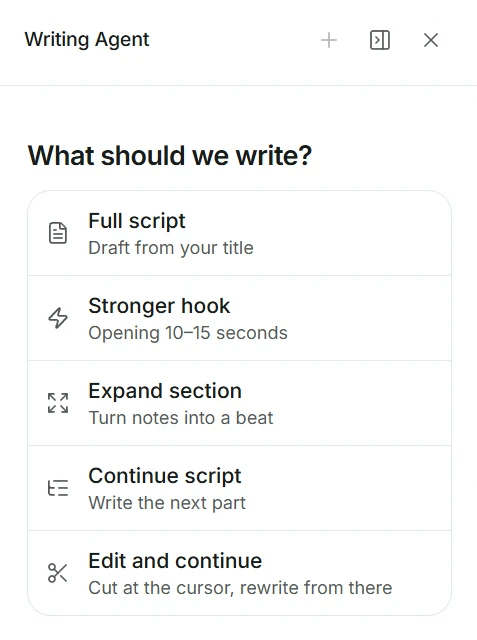
In the Cuely script editor, open the Writing Agent and choose Stronger hook. It rewrites only your opening, keeps the rest of the script, and shows the change so you can keep it or undo it.
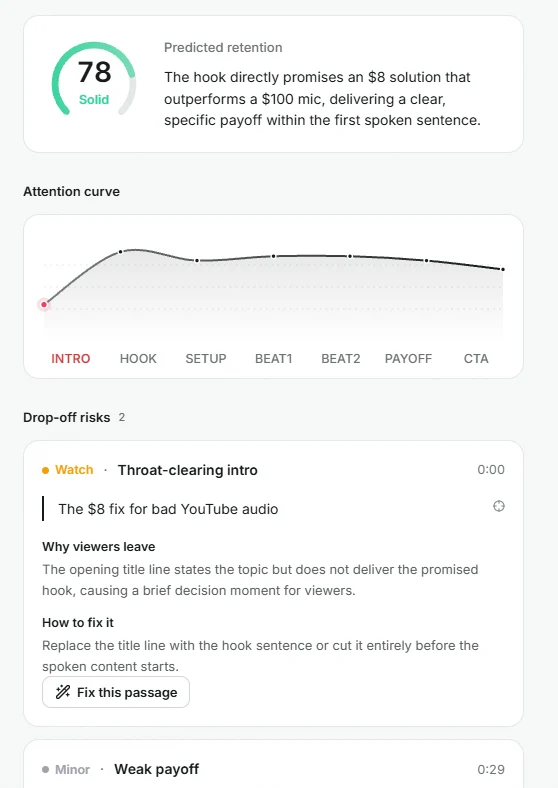
Then run Retention from the top bar. Its first verdict is about the hook: whether the first 15 seconds earn the rest.
Questions
How long should a YouTube hook be?
Two or three spoken sentences, about 10 to 15 seconds. If it takes longer to set up, start later in the story.
Should I say hello or introduce the channel first?
Not before the hook. Viewers decide in the first seconds whether to stay. Say who you are after they know why they are watching, or not at all.
Is a question a good hook?
Only if it is a question the viewer already has and the video answers it. "Have you ever wondered...?" with no clear answer coming is not a hook.